Measurement
The control fabric receives encoder position and phase-current measurements at defined sampling points. The encoder front end supplies quadrature sine and cosine signals, while current measurements feed the FOC regulators.
Deterministic, hardware-implemented field-oriented control for precision electromechanical systems. Sampling, control computation, and output timing follow a fixed hardware data path rather than an interrupt-driven software loop.
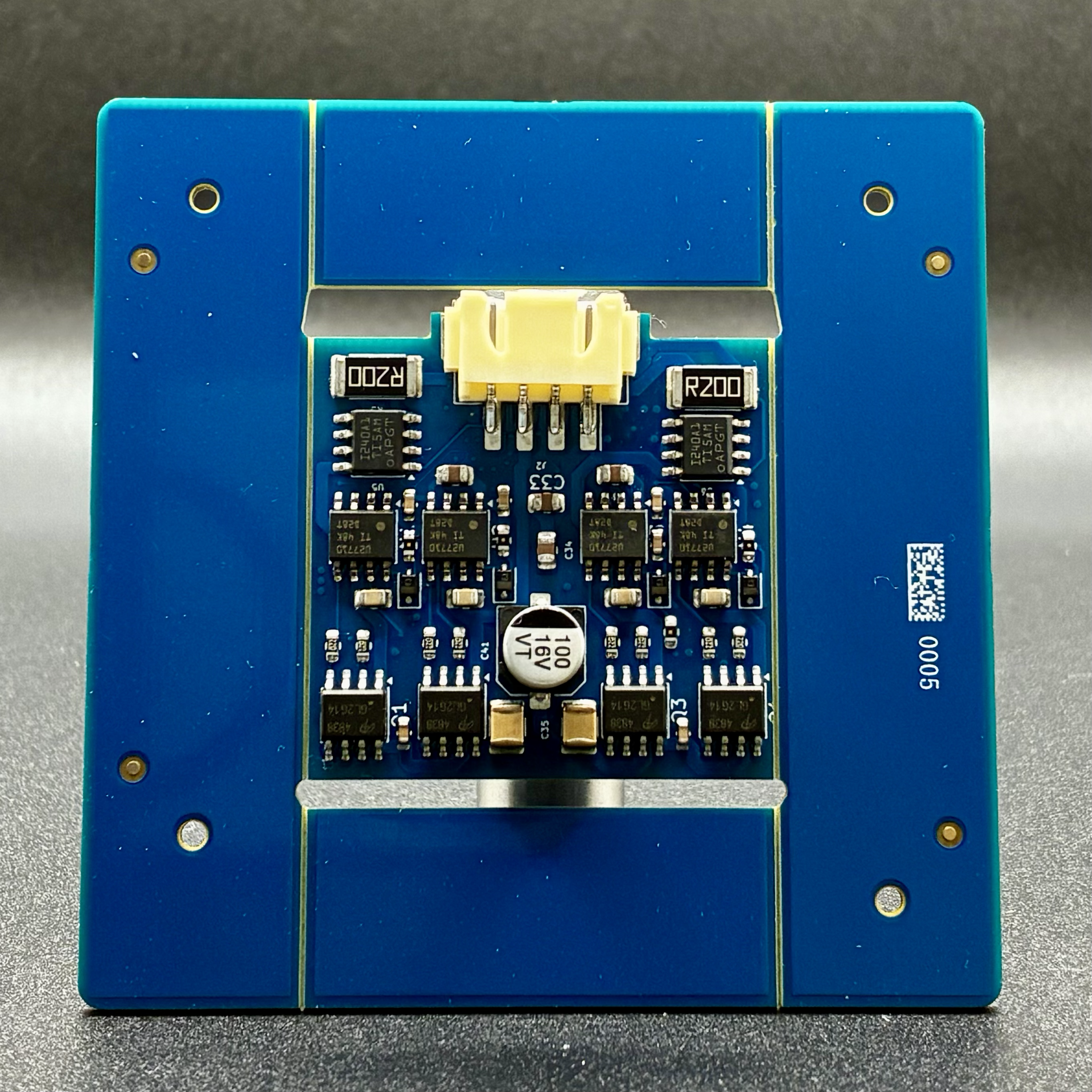
If you are interested in purchasing this control system, or would like to discuss a configuration for a specific actuator or application, contact us to discuss your requirements.
Contact UsThe control fabric implements field-oriented control directly in FPGA logic. The system closes the FOC loop at 80 kHz and expresses the control path as a continuous dataflow structure rather than a sequence of interrupt-driven software tasks.
Encoder processing, coordinate transforms, current regulation, position regulation, feedforward, and PWM generation occupy defined stages in the control path. The hardware architecture therefore establishes the timing of each control operation directly.
The control fabric connects measurement, computation, and actuation through a defined sequence of hardware stages.
The control fabric receives encoder position and phase-current measurements at defined sampling points. The encoder front end supplies quadrature sine and cosine signals, while current measurements feed the FOC regulators.
FPGA logic performs fixed-point position and current regulation, Clarke and Park transforms, feedforward operations, and lookup operations within the control datapath.
The control datapath sends voltage commands through inverse Park transformation, dead-time compensation, PWM generation, and the power bridge that drives the motor phases.
The FPGA architecture defines the timing of measurement, computation, and control output through a clocked hardware pipeline. The system aligns sampling with the motor's commutation cycle and places subsequent computation and output operations at deterministic points within the same control cycle.
The specifications below describe the control architecture and its operating characteristics.
The control system forms one component of a larger precision automation architecture. Control logic, measurement, power electronics, actuator geometry, and calibration data work together when an application requires a configuration beyond the standard product.
If you have a specific control-system application or configuration in mind, contact us to discuss the requirements.